
深度报告|【WEF】:今年全球前十大旅游目的国,花落谁家?
深度报告|【WEF】:今年全球前十大旅游目的国,花落谁家?
世界决定视界 视界决定世界 欢迎关注 全球眼观世界 将全球眼观世界设为星标方能收到正常推送 本期导读:世界经济论坛(World Economic Forum,简称 WEF),是一个以基金会形式成立的国际机构,总部设在瑞士日内瓦州的科洛尼。它以每年冬季在瑞士滑雪胜地举行的“达沃斯论坛”闻名于世,被誉为“非官方的国际经济最高级会谈”。世界经济论坛不仅是一个享有盛誉的非营利性国际机构,更是全球政商界、学术界以及民间社会不可或缺的顶级公私合作平台。 世界经济论坛的诞生,根植于其创始人克劳斯·施瓦布(Klaus Schwab)教授的前瞻性理念。20世纪70年代初,欧洲企业面临来自美国同行日益严峻的竞争压力。时任瑞士日内瓦大学管理学教授的施瓦布敏锐地察觉到这一挑战。1971年2月,在欧洲共同体委员会(现欧盟委员会)的支持下,施瓦布在达沃斯组织了首届“欧洲管理会议”,吸引了400多位欧洲企业高管参与。 施瓦布创立论坛的初衷并非纯粹为了商业利益,而是为了践行他所提出的“利益相关者理论”。他认为,现代企业不仅应该对股东负责、创造经济价值,更应当服务于员工、客户、供应商、社区等更广泛的社会群体,乃至保护地球生态。这种“以全球公共利益为本”的创业精神,成为了论坛自诞生之日起便确立的核心精神内核。 世界经济论坛的半个多世纪发展史,高度契合了全球化进程的起伏波澜。1971年会议大获成功后,施瓦布正式在瑞士日内瓦成立了名为“欧洲管理论坛”的非营利基金会。随着议题逐渐由纯粹的企业管理延伸至更为复杂的全球地缘政治与经济危机(如1973年布雷顿森林体系瓦解、第一次石油危机),论坛的影响力开始超越欧洲边界。1987年,该组织正式更名为“世界经济论坛”,标志着其全球性定位的最终确立。 冷战结束前后,论坛成为了东西方对话、缓和地缘冲突的关键“非官方舞台”。此时,除了冬季年会,论坛开始在全球各个主要区域(非洲、拉美、东亚等)广泛布局区域性峰会。2007年,随着中国等新兴经济体的崛起,论坛将目光投向中国,开启了“新领军者年会”。 2015年1月,瑞士联邦政府正式根据《瑞士东道国法》,赋予世界经济论坛“国际公私合作机构”(International Organization for Public-Private Cooperation)的正式法律地位。这标志着论坛从一个单纯的非政府组织(NGO),跃升为与联合国、世界银行等并驾齐驱的、具有广泛国际公信力的制度性平台。 世界经济论坛致力于树立世界一流的组织治理典范,其结构设计兼顾了战略远见与高效的执行力。基金董事会(Board of Trustees)作为论坛的最高领导与监督机构,由约25至30位来自全球政治、商业、学术和民间社会的杰出领袖组成(其中包括黑石集团CEO劳伦斯·芬克、罗氏控股副主席安德烈·霍夫曼、世界银行行长阿贾伊·班加等)。董事会不参与日常管理,主要负责守护论坛的使命与核心价值观,并制定长远的发展方向与目标。 管理委员会(Managing Board)作为论坛的集体执行机构,由总裁兼首席执行官阿洛伊斯·茨温吉(Alois Zwinggi)以及多位常务董事(Managing Directors)组成。该委员会全面负责论坛的战略落实、财务规划、资源调配以及日常的运营管理,并直接向董事会汇报。 此外,为了针对性研究前沿课题,论坛在瑞士总部及纽约、旧金山、北京、东京的办公室基础上,设立了先进制造、人工智能、网络安全、能源材料、健康医疗等11个专业中心,通过组建专属的行业和专家社区,寻求应对全球挑战的切实方案。 作为一个主要由成员驱动的机构,世界经济论坛的资金来源与核心要素高度依赖于其会员及合作伙伴体系。其成员类型大体上包括战略合作伙伴(Strategic Partners)、论坛会员与行业合作伙伴(Members & Industry Partners)、新领军者社区(New Champions)、数字会员与个人会员(Digital & Individual Members)。 世界经济论坛每年在世界各地举办诸多会议,其中以两大“达沃斯”最具标志性,一个是冬季达沃斯论坛(世界经济论坛年会),一个是夏季达沃斯论坛(新领军者年会)。 冬季达沃斯论坛(世界经济论坛年会)每年1月在瑞士滑雪胜地达沃斯小镇举行。这是论坛的旗舰活动,每次均有来自百余个国家的约3000名国家元首、政府首脑、500强企业CEO、诺贝尔奖得主及主流媒体代表出席。会议不仅是把脉全球经济走向的风向标,也是非官方外交对话的核心阵地。 夏季达沃斯论坛(新领军者年会)自2007年起每年在中国举办,由大连和天津两座城市轮流承办。与偏重宏观宏大叙事的冬季年会不同,夏季达沃斯更聚焦于创新、前沿科技(如AI、生物医药)以及新兴经济体的内生动力。 此外,论坛常年也会在非洲、拉美、东亚及中东等地举办地区性会议,并围绕“可持续发展影响”、“全球技术治理”、“就业与技能复兴”等特定主题召开专项线上及线下峰会。 尽管有人批评达沃斯是“精英阶层的清谈馆”,但不可否认的是,在长期的国际舞台上,世界经济论坛扮演了极其关键的“第二外交渠道”和实质性公共产品推动者的角色。 比如,1988年,希腊和土耳其在达沃斯签署《达沃斯宣言》,成功避免了一场迫在眉睫的战争危机;1992年,南非领导人纳尔逊·曼德拉与时任南非总统德克勒克在达沃斯年会上手挽手并肩站立,论坛为推动南非废除种族隔离、走向和平进程提供了历史性的讲台。 论坛不单探讨议题,更直接推动了具体公共机构的诞生。例如,在2000年达沃斯年会上,论坛大力支持并促成了全球疫苗免疫联盟(GAVI)的正式成立,至今已为全球超过10亿儿童提供了致命疾病的疫苗保障。此外,论坛近年来发起的“全球卫生倡议”、“CEO气候领袖联盟”等,动员了数百家全球大型跨国企业共同参与碳中和与可持续发展转型。 还有,论坛每年发布的《全球风险报告》、《全球性别差距报告》、《未来就业报告》等专业报告,利用其庞大的政商学网络开展综合调研,已成为全球各国政府、智库和企业在做中长期规划时最权威的参考标准之一。 
The top 10 countries for tourism have just been named – and six are in Europe 2026年度全球前十大旅游目的国,花落谁家? 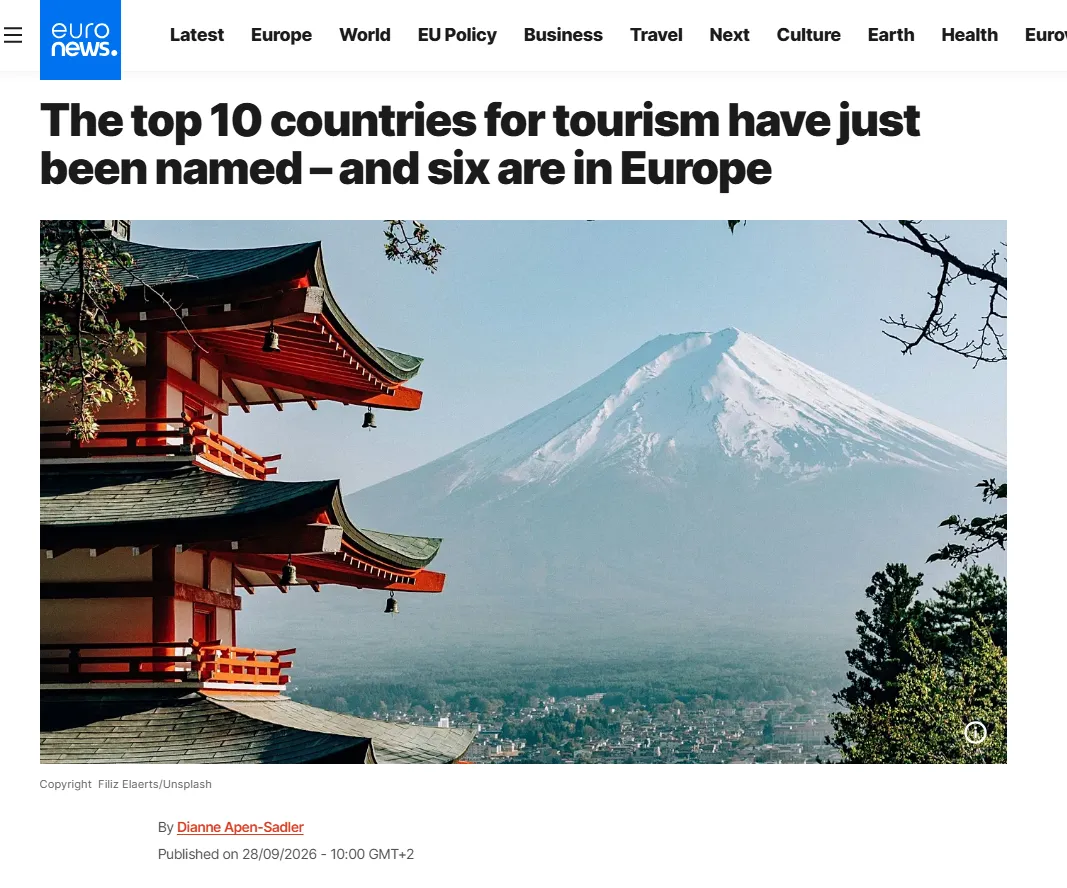
小编注:标题译文仅供参考;下面共享的信息,整理自Euronews和世界经济论坛网站,原文链接见文末;欢迎分享本公众号优质文章,并推荐给需要的朋友,关注星标、点赞在看,不会错过优质信息;更多相关话题优质文章,见文末往期精彩。 While Japan claimed the top spot overall, Albania was named as the fastest improver in the World Economic Forum’s Travel & Tourism Development Index. The 2026 edition of the World Economic Forum’s Travel & Tourism Development Index (TTDI) has just been published, with Europe dominating the top 10. The index looks at factors and policies that enable sustainable and resilient development in the travel and tourism space, under broad pillars like air transport structure, price competitiveness and safety and security. Within these pillars, things like hotel prices, visa requirements, efficiency of public transport, number of UNESCO World Heritage Sites and how tourism is distributed geographically are assessed. While Japan took the top spot overall, Spain came in third, followed by France (fourth), Germany (sixth), the UK (seventh), Switzerland (ninth) and Italy (10th). “The latest Travel & Tourism Development Index shows that the enabling conditions for travel and tourism are at their strongest since the pandemic, with 92% of economies improving since 2024,” Ramya Krishnaswamy, head of experience economy and cities at World Economic Forum, said. “The next chapter is not simply about attracting more visitors, but it is going to be about creating greater value by investing in people, infrastructure and stronger public-private collaboration so tourism delivers lasting benefits for communities, businesses and destinations.” 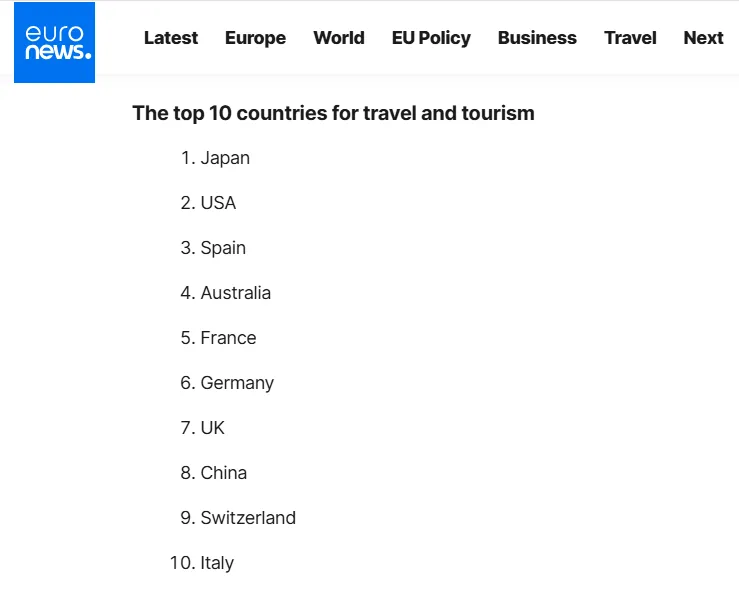
Looking more closely at Japan, the report notes that the country has extended its visitor base and encouraged travel beyond major tourism centres, thereby reducing concentration risk while still welcoming record numbers of travellers. WEF also shared the fastest improvers, with the strongest overall being Albania, with a score increasing by 7% over the past two years. The report notes that the country has “benefitted from offering visitors a more affordable alternative to neighbouring destinations while still providing a compelling tourism experience”. Its score went up thanks to improvements in air transport infrastructure and tourist services. 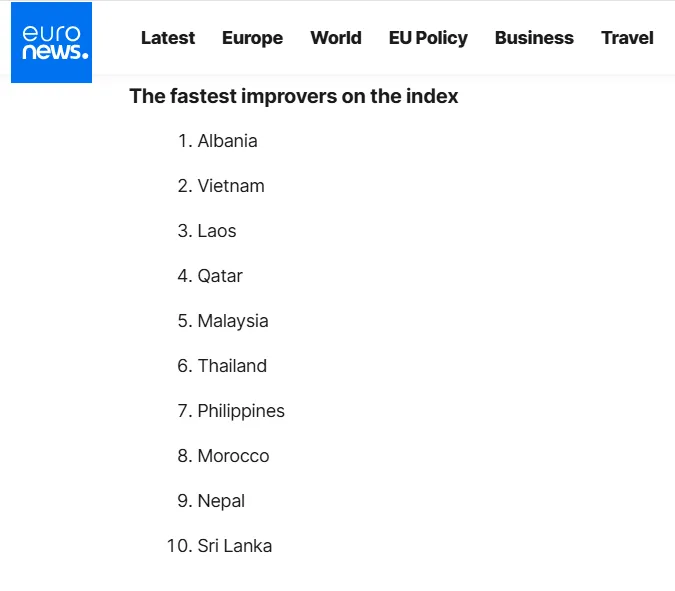
Travel & Tourism Development Index 2026 《2026年度旅游发展指数报告》 The Travel & Tourism Development Index (TTDI) 2026 marks the 10th edition of the World Economic Forum’s flagship travel and tourism benchmarking series, first launched in 2007 as the Travel & Tourism Competitiveness Index and relaunched in its current form in 2022. The Index provides governments, businesses and destination leaders with comparable evidence to identify the conditions and policies that help travel and tourism grow sustainably, withstand disruption and support a country’s development. 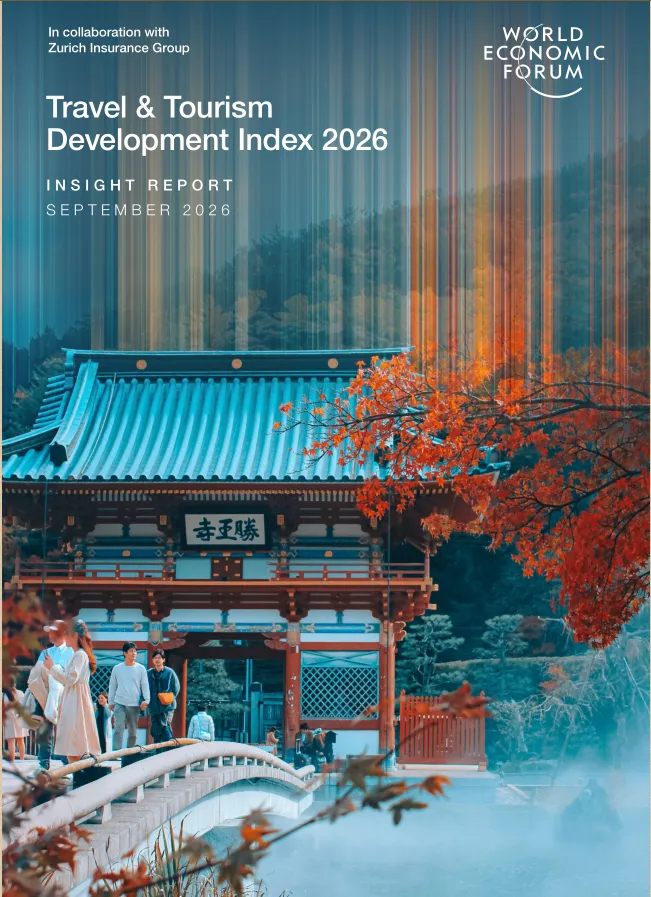
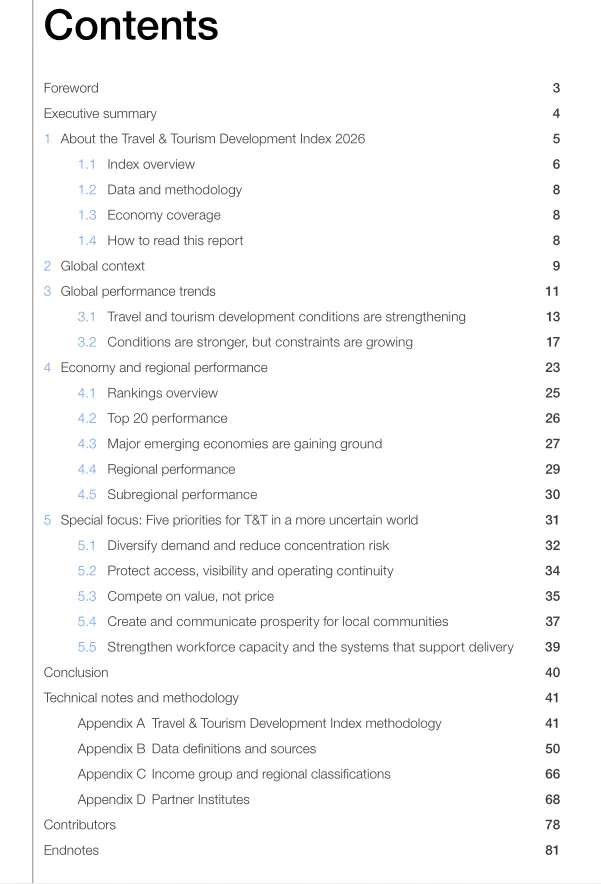
Foreword Recent geopolitical conflict, heatwaves and wildfires around the world are stark reminders of how exposed travel and tourism (T&T) remains to forces beyond the sector’s control. Disruptions in the Middle East and North Africa (MENA) region closed a critical aviation corridor linking Europe, Asia, Australia and Africa, disrupting schedules, capacity, fares and traveller confidence, while climate-driven disruption across Europe and North America exposed mounting operational strain. But disruption is only part of the story. Travel activity and visitor spending have reached record highs, with an estimated 1.52 billion international tourists travelling globally in 2025, according to data from the UN Tourism World Tourism Barometer.1 In 2025, travel and tourism’s total contribution to the global economy reached $11.6 trillion, while domestic visitor spending reached $5.63 trillion and international visitor spending totalled $2.02 trillion.2 The travel and tourism sector also supported a record 366 million jobs worldwide in 2025, representing about one in every nine jobs globally.3 Travel and tourism’s value extends well beyond visitor spending. It supports jobs and local businesses, connects people and places, and helps communities share their culture, heritage and identity with the world. But sustaining this contribution depends on ensuring that growth translates into broader socioeconomic benefits for the places that host T&T – through quality employment, stronger local supply chains, higher public revenue and investment that improves local infrastructure and services. As visitor numbers rise, that task is becoming more difficult. Pressure on infrastructure, housing, natural assets and public services is increasing, while accommodation, transport and operating costs are eroding affordability. At the same time, investment in infrastructure has not kept pace. Without stronger investment and destination management, there is a risk that tourism growth will place greater strain on the very communities and assets on which its long-term success depends. Growth is no longer the challenge. Managing it – without weakening the systems, communities and assets on which long-term tourism success depends – is the opportunity. The Travel & Tourism Development Index (TTDI) 2026 highlights this shift from rebuilding to managing growth. Increasingly, the destinations performing best are those able to convert visitor activity into lasting value. Japan’s rise to the top of this year’s rankings reflects more than visitor appeal. It demonstrates how strong foundations and effective destination management can turn travel and tourism activity into long-term advantage. The choices made by governments, industry and investors will determine whether the next phase of tourism growth is better balanced and better managed than the last. Five priorities stand out: diversifying to reduce concentration risk; protecting access, visibility and operational continuity; competing on value rather than price alone; managing growth to maintain social licence; and strengthening the workforce and delivery systems that allow tourism to function. This edition of the TTDI reflects a collective effort. We are grateful to the members of the Beyond Tourism Insights Council, whose expertise helped shape the 2026 framework and findings: American Express Global Business Travel, the Asian Development Bank, Bloom Consulting, Cinnamon Hotels, Destinations International, the European Travel Commission, the Global Sustainable Tourism Council, Hong Kong Polytechnic University, the International Air Transport Association, the Inter- American Development Bank Group, the JLL Global Tourism and Destination Development Group, Kearney, Microsoft, MMGY TCI Research, New York University, the Pacific Asia Travel Association, Sommet Education, Technogym, Trip.com Group, UN Tourism, the University of Surrey, Visa, the World Bank Group, the World Travel & Tourism Council and Zurich Cover-More. The TTDI helps public- and private-sector decisionmakers to understand what underpins sustainable and resilient tourism development, identify strengths and gaps, and benchmark progress over time. We hope this report supports a more informed debate about the future of the sector and the choices needed to ensure that tourism continues to create benefits for people, businesses and communities. Executive summary The growth outlook for the T&T sector is strong. There is opportunity and risk in managing this growth while strengthening the systems, communities and assets on which long-term tourism success depends. The Travel & Tourism Development Index (TTDI) 2026 points to a sector that has largely moved beyond recovery, with a record 1.5 billion international tourist arrivals in 2025. Tourism assets, connectivity and visitor capacity continue to strengthen across much of the world. But the conditions for success are changing. Affordability pressures, investment gaps, workforce constraints and sustainability challenges are increasingly shaping the sector’s future. Tourism development conditions are at their strongest since the pandemic: Between 2024 and 2026, 92% of the 110 ranked economies improved their TTDI score, and average scores rose by 2.1%, the fastest pace of improvement since 2019. The strongest gains were in cultural attractions, tourism infrastructure and services, and air connectivity, reflecting stronger assets and systems that underpin tourism growth. Advanced economies continue to set the pace: Japan leads the TTDI rankings, while advanced economies account for nine of the top 10 positions, with China the sole exception. European economies hold six places in the top 10, underlining Europe and Eurasia’s position as the highest-performing region overall. The top 10 are Japan, the United States, Spain, Australia, France, Germany, the United Kingdom, China, Switzerland and Italy. Asia-Pacific and emerging tourism economies are gaining ground: The largest emerging tourism economies have improved their TTDI scores more than twice as fast as the top 20 since 2019, benefiting from competitive prices, rich natural assets and more sustainable tourism patterns. Asia-Pacific is driving much of this momentum, accounting for seven of the 10 fastest-improving performers, while Albania was the most improved economy overall between 2024 and 2026. Affordability is one of tourism’s biggest constraints, while investment and workforce gaps persist: Travel and tourism-related prices have risen faster than inflation in many economies, contributing to a decline in price competitiveness in three-quarters of TTDI-ranked economies between 2024 and 2026. Despite improvement, tourism investment has lagged behind activity since 2022, while workforce shortages and skills gaps risk constraining service quality and adaptation to digital and AI-driven change. Tourism growth is not automatically translating into broader benefits: While travel activity and visitor spending continue to grow, the economic and social value generated by tourism weakened between 2024 and 2026, with pressures linked to crowding and visitor concentration remaining above pre-pandemic levels. As a result, managing growth is equally as important as generating it, requiring destinations to share tourism’s benefits more widely while limiting pressure on communities, infrastructure and natural assets. Resilience is becoming a competitive advantage: Climate, economic and geopolitical risks are increasing the importance of resilience. Recent events, including disruptions to international aviation networks following the escalation of the conflict in the Middle East and the heatwaves and wildfires in Europe and North America, illustrate how quickly tourism systems can come under pressure. What singles out successful destinations is not only the strength of their tourism assets, but their ability to adapt and continue functioning during times of uncertainty. 
往期精彩:
欧洲一瞥|【外媒】:欧洲旅游成本大不同,哪些国家比较低? 美国一瞥|【皮尤研究】:美国人民看突发新闻,偏好哪些渠道? 英国一瞥|【外媒】:关于戴安娜的新书对英国王室有啥新爆料 人类一瞥|【外媒】:欧盟成员国中,哪些国家退休年龄最高? 地缘一瞥|【外媒】:塞浦路斯纪念土耳其入侵塞岛52周年 俄熊一瞥|【IMF】:高油价让俄受益但不解决经济根本问题 印度一瞥|【外媒】:印度社会每年平均约有5万人被蛇咬致死 南美一瞥|【外媒】:委内瑞拉宣布大赦过去二十多年间的政治犯 亚洲一瞥|【外媒】:联合国报告称缅甸罂粟种植规模创新高 中东一瞥|【外媒】:伊朗议员谴责女性戴头巾律令没有严格执行 美洲一瞥|【皮尤研究】:美国的委内瑞拉人的状况,长啥样? 环球一瞥|【外媒】:教皇与马克龙首次会晤,双方观点激烈交锋 环球一瞥|【外媒】:金砖峰会上莫迪送书给普京,有何深意? 环球一瞥|【泽连斯基】:已将两个为俄参战朝鲜战俘移送韩国 环球一瞥|【美国威胁称】:欧盟巨额补贴预算将重创双边关系 环球一瞥|【外媒】:伊拉克肉贩“挂牛头卖猪肉”被判监10年 环球一瞥|【外媒】:全球的百万美元富翁,数量增长很“汹” 环球一瞥|【泽连斯基】:普京袭击教堂是对基督教的严重犯罪 环球一瞥|【外媒】:教皇警告整个世界正遭受“暴徒们”的蹂躏 环球一瞥|【皮尤研究】:宗教信徒都趋涨,为啥只有佛教在降 环球一瞥|【外媒】:德国总理称保卫立陶宛,就是保卫德国 智库报告|【皮尤研究】:宗教在美国人民生活中的影响在趋涨 智库报告|【皮尤研究】:西方国家多数人民认为需要政治变革 智库报告|【皮尤研究】:全球各大宗教十年版图变迁研究报告 智库报告|【皮尤研究】:全球范围内哪些宗教信徒流失最严重 智库报告|【皮尤研究】:比较视野下的全球宗教民族主义情势 智库报告|【财富世界】:全球超高净值人士群体年度报告 智库报告|【城市让生活更美好】:世界最佳城市排行年度报告 智库报告|【皮尤研究】:没孩子的美国人都是因为啥没孩子? 智库报告|【皮尤研究】:美国社会中产阶层的演化与变迁


相关文章
发表评论
评论列表
- 这篇文章还没有收到评论,赶紧来抢沙发吧~